 (Image source: Gemini / Landon Phillips)
 If you’ve ever had a nasty scrape, you know the drill: clean it, slap on a band-aid, and wait. But what happens when the wound doesn’t follow the rules? We’re talking about chronic, non-healing wounds—the kind that plague millions globally, especially those with conditions like diabetes or severe burns. These aren't just minor injuries; they’re complex biological failures, often stuck permanently in the inflammatory phase. Think of diabetic foot ulcers or persistent pressure sores. Traditional dressings, usually just passive barriers for absorbing fluid and preventing infection, simply don’t cut it anymore. They fail to address the underlying issues: poor moisture control, raging inflammation, and a complete lack of signals needed to kickstart regeneration.
The good news? We’re entering an era where wound care is less about covering up a problem and more about actively fixing the biology. Bioengineering isn't just offering smarter materials; it’s building personalized, regenerative mini-factories directly onto the skin. This shift is revolutionizing how we heal, moving us from passive protection to active tissue regeneration.
Pillars of Bioengineered Wound Care: Hydrogels and Scaffolds
The fundamental challenge in wound care is recreating the perfect environment for cells to thrive. That means moisture, structure, and communication. Bioengineering tackles this through two primary platforms: hydrogels and scaffolds.
Hydrogels: The Perfect Moist Environment
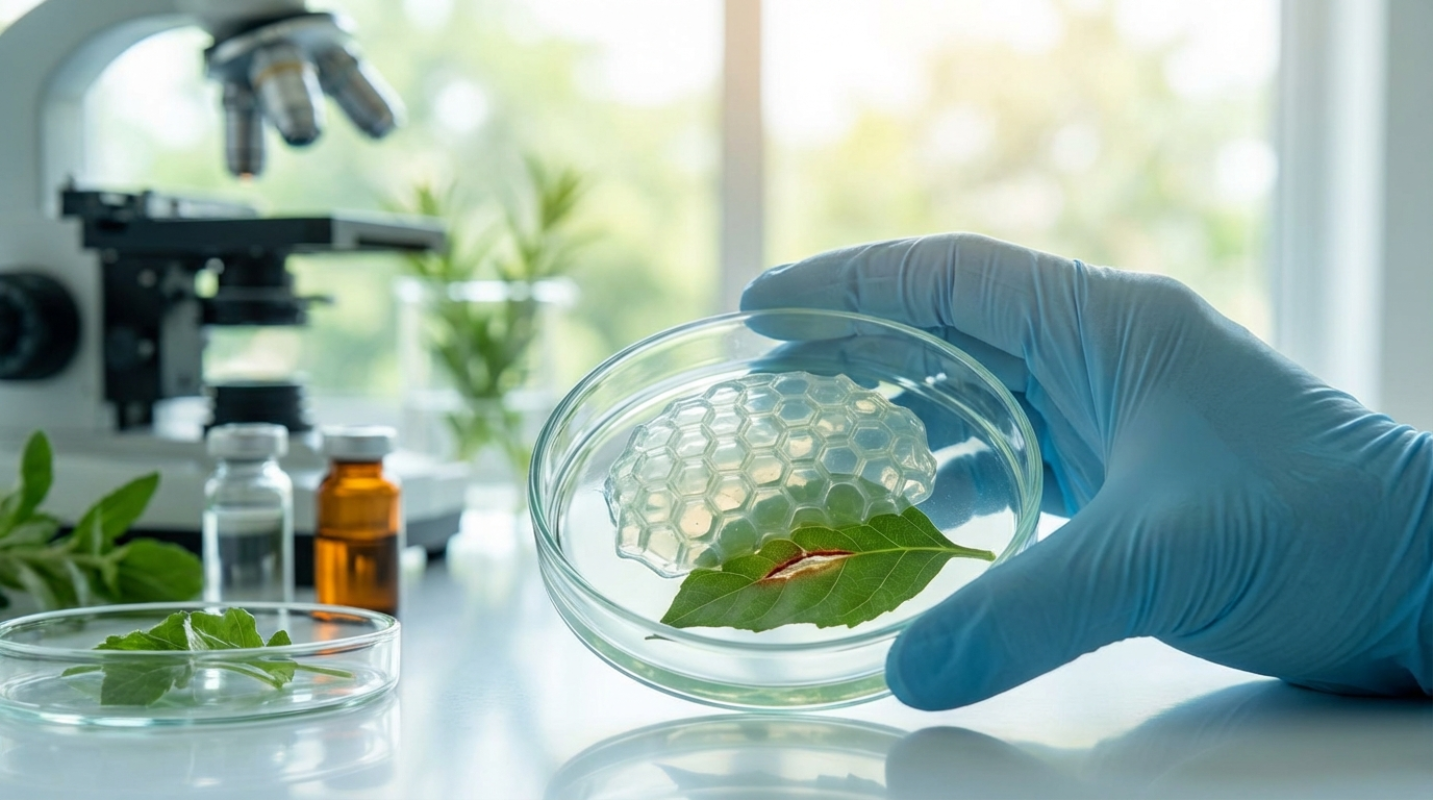
Imagine a dressing that’s a breathable, nutrient-rich Jell-O mold for your skin cells. That's a hydrogel. These materials—made from natural polymers (like chitosan or alginate) or synthetic ones (like PEG)—are masters of moisture management.
They maintain the important moist healing environment necessary for cell migration and enzyme activity. But modern hydrogels are far more than just sponges. They are being engineered to respond to the wound itself. As Limei Cai, an expert in the field, noted in a 2025 review, "We believe that in the near future, stimuli-responsive hydrogel dressings will be used in a wide range of clinical treatments to achieve efficient and high-quality wound healing."¹
Scaffolds: Mimicking the Extracellular Matrix
If hydrogels are the environment, tissue engineering scaffolds are the architectural blueprints. Healing requires new cells to build new tissue, but they need something to cling to and migrate along.
The native extracellular matrix (ECM) is the natural scaffolding of the body, a complex network of fibers and proteins. Bioengineers mimic this structure using techniques like electrospinning, which creates ultrafine, non-woven nanofiber sheets. These nanofibers, often made from polymers like Chitosan-Polyvinyl Alcohol (CS-PVA), possess the high porosity and immense surface area needed to support cell adhesion and growth, effectively acting as temporary rebar for new tissue.⁷
In fact, these nanofiber scaffolds are proving incredibly powerful. In animal models, PVA-chitosan nanofibers achieved a stunning wound closure rate of $90.76 \pm 4.3\%$ after seven days, drastically outperforming traditional methods.⁶
Smart Materials: Sensing, Responding, and Drug Delivery
The most exciting development is the integration of intelligence into these materials. Your dressing shouldn't just sit there; it should be listening, sensing, and responding.
The Digital Doctor on Your Skin
We’re now seeing the emergence of AI-integrated conductive hydrogels that are the digital equivalent of a dedicated nurse monitoring the wound 24/7. These smart dressings track physiological signals like temperature, pressure, and the chemical composition of the wound fluid.²
Why is this important? Because infection or healing stall can be detected before visual symptoms appear. Machine learning algorithms process this data—tracking pH, glucose levels, and even pain signals—to predict healing stages and detect infections early with an accuracy of up to 96%.² This innovation offers a new model in personalized wound care by providing continuous, non-invasive insights into your recovery status.
Precision Drug Release
The key to treating chronic wounds is regulating the harsh, acidic, and inflammatory environment. Bioengineered materials achieve this through controlled release systems.
Like, researchers have developed hydrogels that are specifically pH-responsive. When the wound becomes overly inflamed and acidic (a common characteristic of chronic wounds), the hydrogel detects this change. It then releases beneficial compounds that modulate the pH from around 7.0 down to a slightly acidic 6.5. This subtle shift is highly strategic because it promotes the polarization of macrophages to the M2 type—the kind of immune cell that reduces inflammation and accelerates healing.³
Plus, these platforms can deliver powerful therapeutics like growth factors (such as VEGF or PDGF) or novel peptide-based antimicrobials precisely where they are needed, minimizing the systemic side effects that come with oral medication.
Regenerative Frontiers: Cell-Free and Cellular Therapies
If you want true tissue regeneration, you need more than just structure; you need the actual biological instructions. That brings us to the cutting edge of bioengineering: cell-free and cellular therapies.
Exosomes: The Body’s Healing Mail Carriers
Stem cell therapies have long held promise, but they come with logistical and regulatory headaches. Enter exosomes. These nanoscale vesicles, secreted by cells, are neededly tiny regenerative delivery trucks. They carry all the necessary cargo—proteins, lipids, and RNA—to tell damaged cells how to repair themselves.
Because they are "cell-free," they have superior stability and reduced immunogenicity, making them a safer, more stable alternative to traditional stem cell treatments.⁴ Researchers are now integrating these exosomes into hydrogel bandages. A significant advancement in late 2024 involved developing a bioprinted, exosome-laden hydrogel bandage that uses lyophilized (freeze-dried) exosomes, making sure they are shelf-stable and retain their bioactivity.⁴ This technology could be fabricated at the point-of-need, suitable for use in remote or austere environments.
Exosome-based dressings accelerate healing by boosting angiogenesis (new blood vessel formation) and reepithelization, while also significantly decreasing scar formation.⁴
Bio-Printed Skin and Pain Management
The dream of "printing" new skin is quickly becoming reality. Bio-printed skin substitutes and living wound matrices provide immediate, functional coverage.
But even simpler bioengineered materials are dramatically improving patient quality of life. Consider pain management. A recent clinical trial (2025) using an electrospun nanopolymer film, Spincare™, showed that patients reported a significantly higher rate of complete pain relief by Day 10 (46.6%) compared to the control group (6.6%).⁵ This highlights how the protective, non-adherent properties of these advanced films minimize the trauma and friction associated with painful dressing changes.
The Convergence of Biology and AI
We are witnessing a deep shift in clinical practice. The days of simply covering a wound are ending; the future involves sophisticated, personalized treatment plans driven by data and biological instruction.
The materials we’ve discussed—smart hydrogels that monitor pH, nanofiber scaffolds that guide cell growth, and exosome-loaded dressings that deliver regenerative signals—are moving rapidly from lab benches to hospital beds. This convergence promises faster healing but also vastly improved patient outcomes, including reduced hospitalization times and a lower risk of amputation, particularly for diabetic patients.
The biggest challenge remains scaling up production and understanding the regulatory pathways, especially for living or cell-free materials that the US FDA has yet to fully approve for widespread human use.⁴
Ultimately, the future of wound care in 2026 and beyond is defined by the seamless integration of materials science, biology, and Artificial Intelligence. You won’t just be getting a dressing; you’ll be getting an intelligent, regenerative assistant designed specifically for your body’s unique needs. This isn't just better medicine; it's smarter healing.
Sources:
1. Engineered stimuli-responsive hydrogel dressings for wound healing
2. AI-powered hydrogel dressings transform chronic wound care
3. A Stimuli-Responsive Bioactive Hydrogel Dressing for Diabetic Wound Healing
4. Bioprinted Exosome-Laden Hydrogel Bandage for Operational Medical Applications
5. Randomized controlled trial comparing Spincare™ with conventional dressings in burn care
This article is for informational and educational purposes only. Readers are encouraged to consult qualified professionals and verify details with official sources before making decisions. This content does not constitute professional advice.