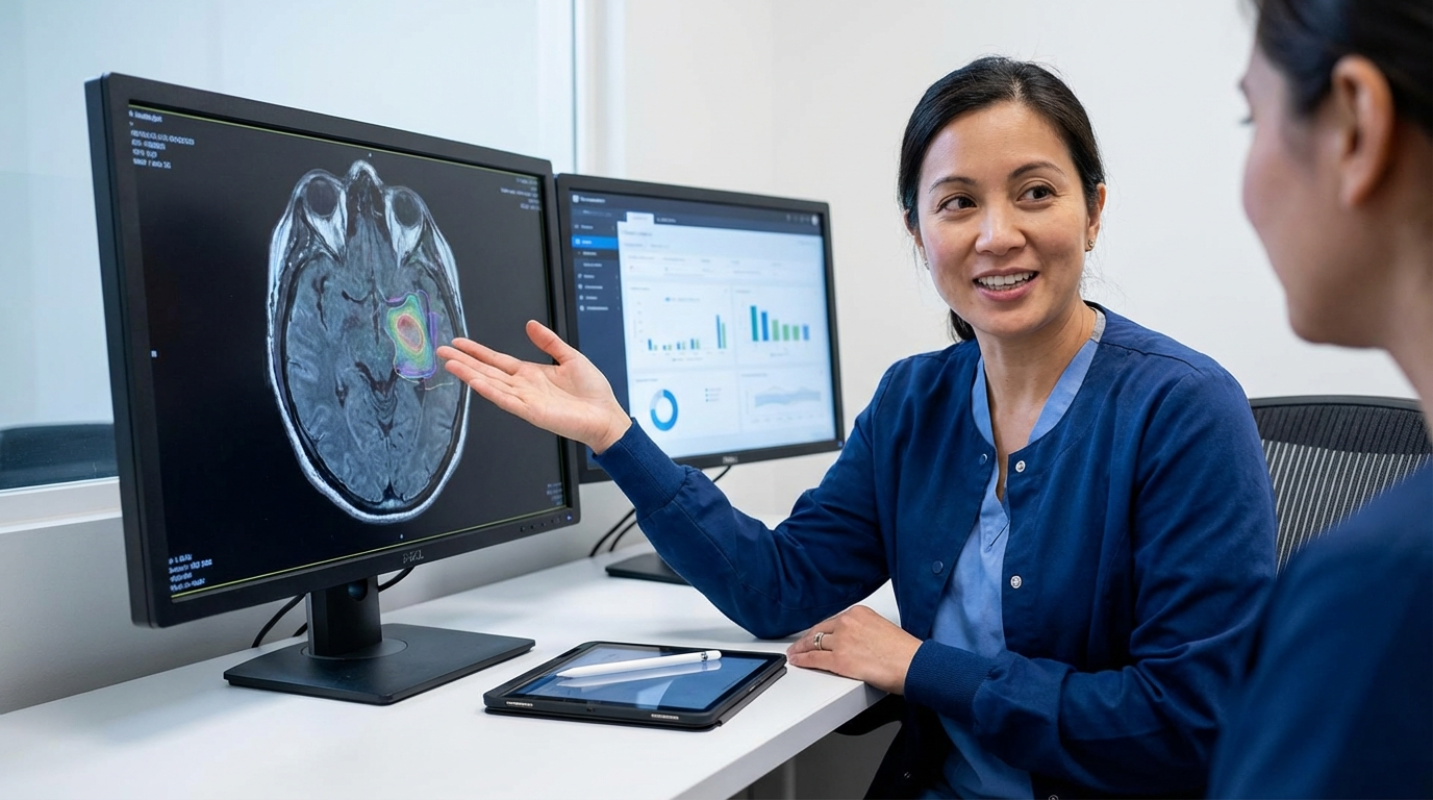
 (Image source: Gemini / Landon Phillips)
 If you’ve ever waited anxiously for a medical scan result, you understand the high stakes involved. Radiology isn't just about taking pictures; it’s about interpreting those pictures—a complex, high-pressure task where the slightest missed detail can change a life. Radiologists are brilliant, highly trained specialists, but they are also human. They get tired. They deal with staggering volumes of images.
That’s where artificial intelligence steps in.
For years, the conversation around AI in radiology focused on speed and workflow efficiency. Could AI triage urgent cases faster? Could it automate measurement? Yes, it could. But the real game-changer now is accuracy. We’re moving beyond simply making the radiologist faster to making them demonstrably better.
Deep learning (DL) tools—the sophisticated algorithms that analyze millions of images to recognize patterns—are now functioning as intelligent co-pilots. They are designed not to replace the doctor, but to act as a tireless second set of eyes. The thesis is simple: AI assistance is measurably improving scan accuracy and consistency, lowering the rate of dangerous false negatives and improving patient outcomes.
The Mechanics of Accuracy — How AI 'Sees' What Humans Might Miss
When a radiologist reviews a CT scan or an X-ray, they are looking for abnormalities, often against a background of noise or subtle anatomical variations. It’s an incredibly demanding pattern recognition exercise.
AI excels here because it doesn't suffer from cognitive fatigue, nor does it rely on memory of the last case it saw. It can process thousands of tiny data points simultaneously.
Automated Detection and Quantification
The core mechanism involves three functions
- Detection: AI algorithms are trained to flag potential areas of concern, such as a pulmonary nodule or a microcalcification in breast tissue. These algorithms are often better at spotting extremely subtle patterns that might be overlooked during a fast read.
- Segmentation: Once detected, the AI precisely outlines the abnormality. This gives the radiologist exact quantitative data—volume, density, and growth rate—which matters for tracking disease progression.
- Quantitative Analysis: This is where the machine truly shines. Humans rely on subjective measurements; AI provides objective, repeatable data.
Think of lung cancer screening. A tiny, ambiguous lesion on a mammogram or CT could be benign, or it could be a stage 1 cancer. When radiologists used an AI algorithm during breast cancer screening, they achieved an 18% higher cancer detection rate compared to conventional double reading.⁶ That’s not just a small improvement; that’s catching cancers earlier, potentially saving lives. The AI doesn't just point out the obvious; it flags the lesions that are small, ambiguous, and easy to miss when the reading queue is long.
Specific Applications Driving Measurable Improvements in Scan Accuracy
AI is now integrated across nearly every imaging modality, standardizing interpretation and reducing the frustrating issue of inter-observer variability—the differences in interpretation between two equally skilled radiologists. By providing a consistent baseline, AI make sures that a patient receives the same high quality of interpretation regardless of which shift is reading their scan or which facility they visit.
Beyond the Scan — Triage and Missed Opportunities
The impact is particularly dramatic in high-volume areas like chest X-rays (CXR). CXR is often the first, cheapest screening tool, but it’s notorious for subtle findings that are missed or misinterpreted, especially in patients who don’t fit standard screening criteria.
Recent studies confirm AI’s power here. A deep learning model used routine chest radiographs to predict lung cancer risk. It successfully identified individuals who were not considered high-risk by traditional criteria but still had a 3.3% six-year incidence of lung cancer.² This means the AI found a significant number of high-risk patients that human interpretation, bound by established clinical guidelines, would have missed entirely.
We’re seeing similarly powerful applications in
- Stroke Triage: AI platforms like Viz.ai are now standard, immediately flagging suspected large vessel occlusions on CT scans and notifying the stroke team within minutes. This rapid triage dramatically cuts down the time to intervention, which is important for brain tissue preservation.
- MRI Quality: AI-assisted reconstruction shortens scanner times and improves image quality even at reduced doses, helping to mitigate the perennial problem of patient motion artifacts, which can completely ruin a scan’s diagnostic value.
AI is routinely shown to exceed 95% accuracy in specific, narrow diagnostic tasks, such as detecting specific lung findings or identifying retinal diseases.³ This level of consistency is impossible to maintain across a human workforce facing shift work and high caseloads.
Integration Challenges and the 'Human-in-the-Loop' Approach
If AI is so accurate, why isn't it running the show entirely? The challenge isn't just technological; it’s cognitive and regulatory.
As of mid-2026, the FDA has cleared approximately 873 AI-enabled tools for medical imaging tasks, with 115 new algorithms added recently.⁴ This explosive growth proves clinical acceptance is high.
But AI is designed to be an assistant, not a replacement. This concept is called augmented intelligence. The human radiologist retains the ultimate clinical stewardship because the algorithms, while powerful, lack the context of the patient's full medical history, lab results, and physical exam findings.
The Danger of Automation Bias
The biggest threat to accuracy, ironically, is over-reliance on the tool. This is known as automation bias.
If the AI flags something, the radiologist is highly likely to agree. If the AI misses something (a false negative), the radiologist might overlook it too, assuming the algorithm has already validated the scan as clean. A multi-reader study demonstrated that when AI was manipulated to produce a false negative, the human false negative rate skyrocketed to as high as 33.0% in some conditions.⁷
This stark finding shows why training and workflow integration matter. The AI must be implemented carefully—perhaps only flagging urgent cases or providing a confidence score—to make sure the radiologist remains actively engaged in the diagnostic process.
The Future Trajectory — Precision, Prediction, and Next-Generation Tools
The current generation of AI is fantastic at detection. The next generation is focused on prediction.
We’re moving toward predictive diagnostics, where AI doesn’t just tell you what disease you have, but how that disease will progress, and which treatments are most likely to work. This prognosis capability relies on advanced deep learning models that can process not just the image pixels, but also the text from your electronic medical records (EMR) and prior reports.
The field is changing from fixed, single-task models (e.g., "detect lung nodules") to foundation and generative models—similar to the large language models (LLMs) you might use for writing, but applied to medical data.¹ These models will enable entirely new applications, such as automated draft report generation that synthesizes findings from multiple scans and clinical notes, further streamlining the radiologist’s work and reducing the chance of transcription or synthesis errors.
Ultimately, the transformation AI brings to radiology is deep. By providing powerful, consistent detection capabilities, AI assists the radiologist in achieving higher accuracy rates. This doesn't just mean better scan interpretation; it means catching diseases earlier, reducing unnecessary follow-up costs, and delivering the most important result of all: optimized patient outcomes.
Sources:
4. AI in Radiology Impact and Practice
5. Deep Learning and Automation Bias in Radiology
This article is for informational and educational purposes only. Readers are encouraged to consult qualified professionals and verify details with official sources before making decisions. This content does not constitute professional advice.