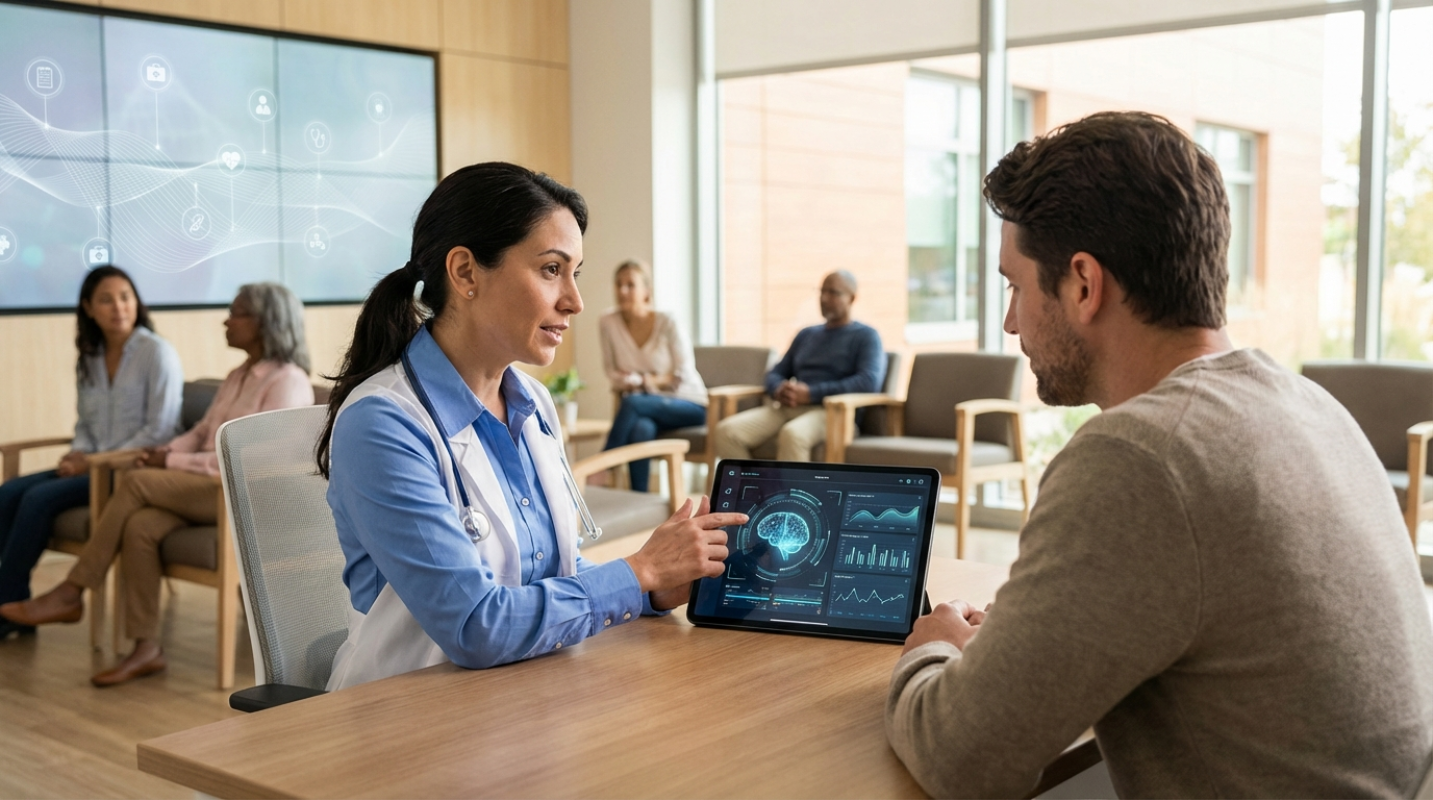
 (Image source: Gemini / Landon Phillips)
 If you’re a primary care provider, you know the drill. A patient walks in with vague symptoms—a cough, fatigue, a weird rash—and suddenly, you’re trying to cross-reference their complex history, their latest lab results, and the three new guidelines published this morning. It’s a massive amount of information to synthesize in a 15-minute slot. Sound familiar?
This is why AI-driven Clinical Decision Support Systems (CDSS) are no longer a futuristic concept; they are becoming needed tools, especially in the busy world of outpatient medicine. Forget the clunky, rule-based systems of the past that just threw annoying alerts at you. Today’s AI CDSS use sophisticated machine learning and deep learning to look at millions of data points, offering real-time, personalized guidance.
The thesis is simple: AI CDSS are changing past simple safety nets. They are becoming indispensable partners, allowing primary care physicians to make confident, precise diagnoses and treatment plans, fundamentally changing how we deliver care.
Beyond the Basics: What Modern AI CDSS Actually Do
What separates today’s cutting-edge AI from the antiquated systems that caused rampant alert fatigue? It’s the shift from static, if-then rules to dynamic, learning algorithms.
Modern CDSS are fueled by machine learning and even Large Language Models (LLMs) which analyze unstructured data—like clinical notes and rapidly changing medical literature—faster than any human could. This allows them to perform several key tasks directly within your Electronic Health Record (EHR) workflow
- Risk Stratification They can flag patients at high risk of rapid decline or readmission, sometimes detecting clinical issues up to 42 hours earlier than traditional methods. In one trial using an early warning AI system, this led to a 35% reduction in mortality risk for high-risk patients.³
- Differential Diagnosis Generation Instead of relying solely on your memory, the AI sifts through data to suggest less common but possible diagnoses based on subtle symptom patterns.
- Personalized Treatment Pathways The system doesn't just offer standard advice. It considers the patient's specific genetics, lifestyle, and comorbidities to recommend a truly tailored care plan.
Perhaps the most immediately impactful advancement for the busy primary care physician is the rise of "AI scribes" and Ambient Clinical Intelligence. Studies show that automating note-taking and documentation is ranked by 57% of physicians as the top opportunity for AI to reduce administrative burden and burnout.³
That’s a game-changer for reclaiming your evenings.
The Confidence Boost: Enhancing Clinician Performance and Reducing Errors
The primary role of an AI partner isn't to replace your clinical judgment; it’s to make your judgment better. Think of the AI as the smartest, most detail-oriented research assistant you could hire.
This collaboration is proving important in improving diagnostic accuracy. Like, AI-powered tools have demonstrated the ability to detect certain cancers with 94% accuracy, exceeding the 88% accuracy achieved by human specialists alone.³ This difference matters, especially when early detection matters.
Successful implementation of these systems shows tangible benefits. A case study focusing on medication safety and sepsis detection demonstrated that integrating an AI CDSS led to a massive 50.8% reduction in the medication error rate and a 55.3% reduction in the alert override rate—meaning doctors actually trusted the alerts they were receiving.⁸
This improved trust is important. When the system is accurate and seamlessly integrated, it reduces unwarranted variation in care and gives you the assurance that you haven't missed a important piece of information, allowing you to practice with greater confidence.
Real-World Impact: Successful Adoption and Key Use Cases
The adoption of AI in outpatient settings is accelerating rapidly. By late 2024, an AMA survey found that 66% of U.S. physicians were already using AI tools in their practice, a dramatic surge from previous years.⁴ A late-2025 study further cemented this trend, showing that 50% of ambulatory care practices were using at least one AI tool.⁵
One of the most successful, high-volume outpatient applications is autonomous AI screening for diabetic retinopathy. This technology allows primary care doctors to perform instant detection right in their office, rather than relying on specialist referrals. By 2025, the primary care setting accounted for over 40% of the market share for this specific technology.²
This trend isn't just about big hospital systems anymore. It’s about community clinics and private practices adopting tools that have been rigorously vetted. As of mid-2024, the FDA database listed 882 AI- and machine learning-enabled devices, confirming a strong and regulated pipeline of clinically validated support tools.⁷
Top Recommendations for AI CDSS Integration
If you’re considering bringing AI CDSS into your practice, focus on solutions that prioritize seamless EHR integration and transparency. Look for tools that specialize in chronic disease management—like hypertension or diabetes—where longitudinal data analysis offers the greatest benefit.
Understanding the Future: Ethics, Trust, and Scalability
Although the technology is powerful, successful adoption hinges entirely on trust. You need to know why the AI is making a recommendation. That’s where Explainable AI (XAI) comes in. Transparency is paramount for building clinician confidence and avoiding the pitfalls of automation bias.
We also have to address the patient perspective. There’s currently a "trust gap": while 79% of doctors expect AI to improve patient outcomes, only 59% of patients share that same confidence.⁶ Bridging that gap requires thoughtful communication and governance.
The path forward demands that we manage data privacy and make sure these powerful tools are scalable and accessible, not just for large urban systems, but for rural and underserved clinics too. The goal isn't just better technology; it’s equitable, widespread adoption. By thoughtfully integrating AI CDSS, we make sure that the future of outpatient care is smarter but also inherently more human, freeing up clinicians to focus on the patient, not the paperwork.
Sources:
1. AI-Driven Clinical Decision Support Systems: The Future of Healthcare
2. US AI-Driven Diabetic Retinopathy Screening Market Size Report, 2025
3. How Artificial Intelligence is Improving Primary Care in 2025
4. AI Adoption in US Hospitals and Healthcare Systems (2024-2025)
5. AI Adoption in Private Medical Practices and Outpatient Clinics (2025)
This article is for informational and educational purposes only. Readers are encouraged to consult qualified professionals and verify details with official sources before making decisions. This content does not constitute professional advice.