 (Image source: Gemini / Landon Phillips)
 For decades, the hospital was the undisputed center of the medical universe. If you were truly sick—suffering from conditions like severe pneumonia, congestive heart failure, or deep infections—you went to the inpatient unit. That was the rule.
But that rule is rapidly changing.
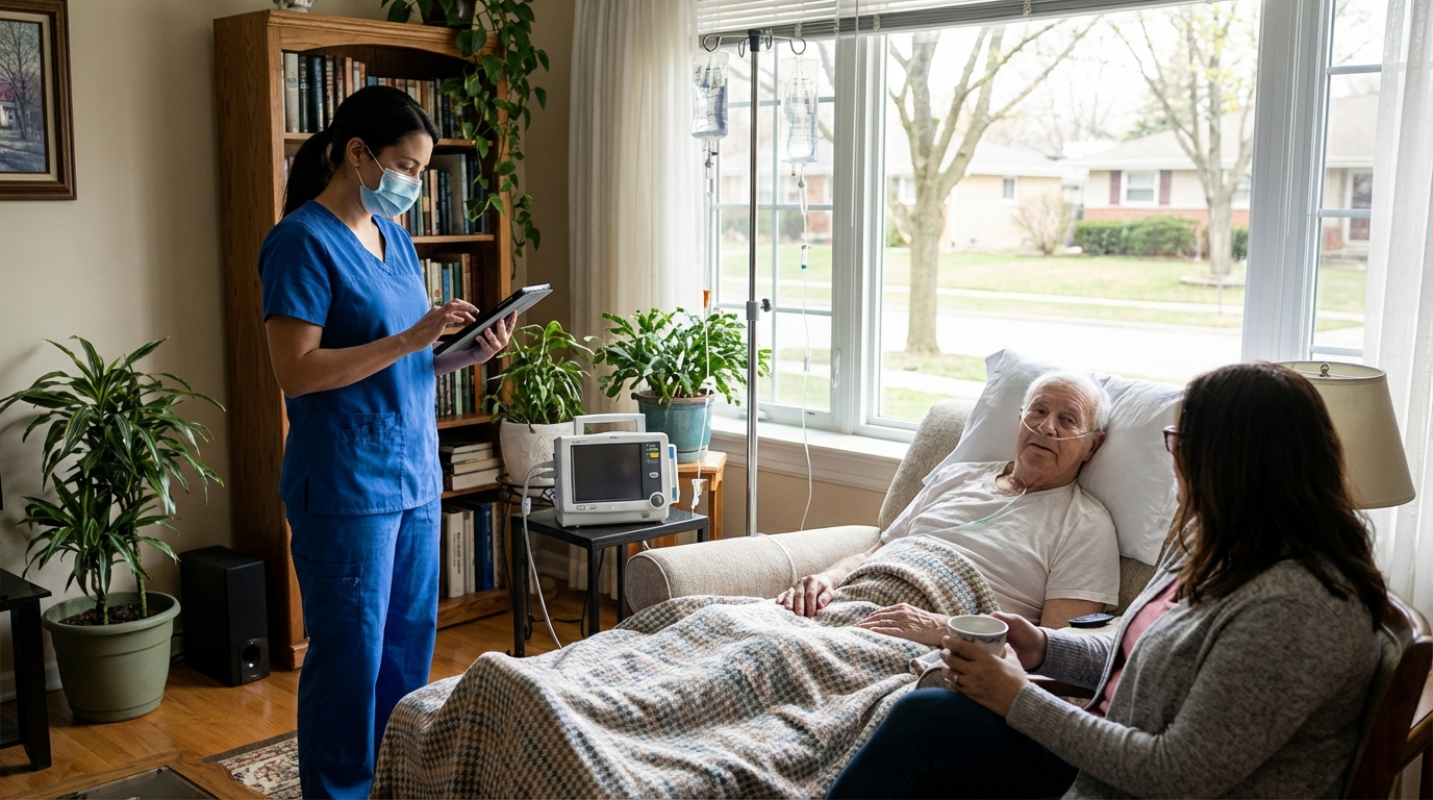
Thanks to a convergence of advanced technology and a shift toward value-based care, acute medical treatment is moving out of the sterile, traditional hospital environment and right into your living room. This isn't just skilled nursing or home health; this is Hospital at Home (HaH)—a model where patients receive true, inpatient-level care complete with daily physician visits, IV medications, and continuous monitoring, all without leaving their beds at home.
The idea isn't new, but its expansion is unprecedented. What began as an experimental pilot program has been supercharged by policy waivers and clinical success, making HaH one of the most important movements redefining acute care delivery in the 2020s. It’s moving from a novel concept to a mainstream option, driven by irrefutable quality outcomes and powerful economic incentives.
The Drivers Behind the Expansion: Economics, Quality, and Access
Why the sudden explosion of interest in HaH? The simple answer is that it works better and often costs less.
The primary catalyst for nationwide growth was the Centers for Medicare & Medicaid Services (CMS) Acute Hospital Care at Home (AHCAH) waiver. Introduced during the COVID-19 pandemic to alleviate overwhelmed hospitals, the waiver allowed approved facilities to receive Medicare reimbursement for acute care delivered in the patient's home. This legislative change cracked open the door for large-scale adoption.
The clinical data supporting HaH is compelling. Studies show that patients treated under these models often experience lower mortality rates and significantly reduced post-discharge spending compared to those treated in traditional inpatient settings.¹ Think about it: fewer exposure risks mean lower infection rates. Plus, recovering in a familiar environment improves sleep and reduces delirium, leading to better overall outcomes.
Plus, HaH is a key tool for addressing the persistent challenge of hospital capacity relief. When hospitals are bursting at the seams—a constant issue across the country—moving appropriate patients home frees up desperately needed beds for complex surgical cases or intensive care patients. This operational efficiency is a massive economic driver for health systems facing increasingly tight margins.
Technology as the Backbone: Enabling Safe and Effective Remote Monitoring
You might be asking, "How can my doctor monitor my heart failure from miles away?" The answer lies in sophisticated, integrated technology.
The backbone of any successful HaH program is the Remote Patient Monitoring (RPM) stack. This usually includes hospital-grade devices—like continuous key sign monitors, pulse oximeters, and blood pressure cuffs—that wirelessly transmit real-time data to a centralized command center. Artificial intelligence (AI) is increasingly integrated to analyze these data streams, offering predictive analytics that flag subtle changes in a patient's status before they become important.
But technology alone isn’t enough. HaH is a hybrid model. The virtual care—telehealth consultations with physicians and 24/7 monitoring—is supplemented by the needed human element. Nurses, paramedics, and technicians provide scheduled, twice-daily in-person visits and rapid response teams are always on standby, ready to rush to the patient’s home within minutes if the remote monitoring flags an emergency.
This complex ecosystem requires seamless data flow. Making sure that home devices are interoperable with the hospital’s core Electronic Medical Records (EMR) system is a huge logistical undertaking. If the data isn't immediately visible to the entire care team, the safety margin shrinks. Health systems are pouring resources into solving these connectivity challenges to make sure the care you receive at home is as safe, or safer, than the care you’d get in Room 302.
Case Studies and Current Space: Who is Leading the Charge?
The sheer number of providers authorized to participate is staggering. As of late 2025, CMS had approved 419 hospitals across 39 states to participate in the AHCAH waiver.² This suggests a sweeping national focus on the model.
But the reality of utilization tells a more nuanced story. Despite the high number of approved hospitals, the model remains highly concentrated. A June 2024 report revealed that HaH admissions accounted for less than 1/10 of 1% of Medicare fee-for-service inpatient admissions.³ So, what’s going on?
The low utilization rate points to significant scalability hurdles. Standing up a strong HaH program requires massive initial investment in specialized logistics, staffing (including training home-care coordinators), and technology infrastructure. Less than 9% of approved hospitals account for over 70% of all U.S. admissions, while nearly two-thirds of approved hospitals have reported zero admissions.³ This suggests that while large, well-capitalized systems (like Mayo Clinic or integrated delivery networks) are succeeding in scaling these programs, smaller or regional hospitals are struggling to clear the operational bar.
Yet, experts remain bullish. The global hospital-at-home market is projected to grow from $17.3 billion in 2025 to over $193 billion by 2035—a compound annual growth rate of over 27%.² This massive forecast reflects the consensus that these operational challenges are temporary, provided the policy environment stabilizes.
Stabilizing the Standard: The Important Role of Policy and Payer Adoption
The single biggest roadblock to HaH stability and expansion has been policy uncertainty.
The CMS waiver, while revolutionary, has been extended in short, stressful increments. Imagine trying to invest millions in staffing and equipment knowing your revenue stream might disappear in six months. This instability has been paralyzing for many providers. Like, the waiver briefly lapsed in late 2025 before being extended again until January 2026.⁵
To combat this, Congress has stepped up. In a major move, the House of Representatives passed the Hospital Inpatient Services Modernization Act (H.R. 4313) in December 2025. This bipartisan bill would grant a important five-year extension of the AHCAH program through September 30, 2030.⁴ If the Senate passes this measure, that stability will unlock the necessary investment for providers to scale programs confidently.
Beyond Medicare, the other important hurdle is payer adoption. Although Medicare has led the way, wider commercial insurance coverage is needed for HaH to achieve true nationwide expansion. As more clinical data confirms the safety and cost-effectiveness of these programs, commercial payers are beginning to recognize that HaH is not a novelty, but a value-based solution.
The future of acute care won't be defined by a single building. It will be defined by the ability to deliver high-quality, continuous care wherever the patient is most comfortable. HaH is shifting the power dynamic, allowing providers to gain important insight into your home environment, which helps better patient engagement and self-management. This model isn't just an alternative; it's rapidly becoming the standard acute care option for millions of Americans, signaling a fundamental, long-term change in how we think about hospitalization.
Sources:
1. AHA Fact Sheet: Extending Hospital at Home Program
2. Hospital At Home Market Set for Rapid Expansion
3. Hospital at Home Care’s Future Still Hangs in the Balance
4. House passes bill extending Hospital at Home waivers for five years
5. Six More Months of Hospital at Home: A Step Forward for Patients and Providers
This article is for informational and educational purposes only. Readers are encouraged to consult qualified professionals and verify details with official sources before making decisions. This content does not constitute professional advice.