 (Image source: Gemini / Landon Phillips)
 If you or someone you love manages diabetes, you know the drill. It involves needles. Whether it’s the constant prick of a fingerstick or the insertion of a continuous glucose monitor (CGM) sensor, blood sugar management is inherently invasive. It’s painful, it causes anxiety, and it often leads to compliance fatigue.
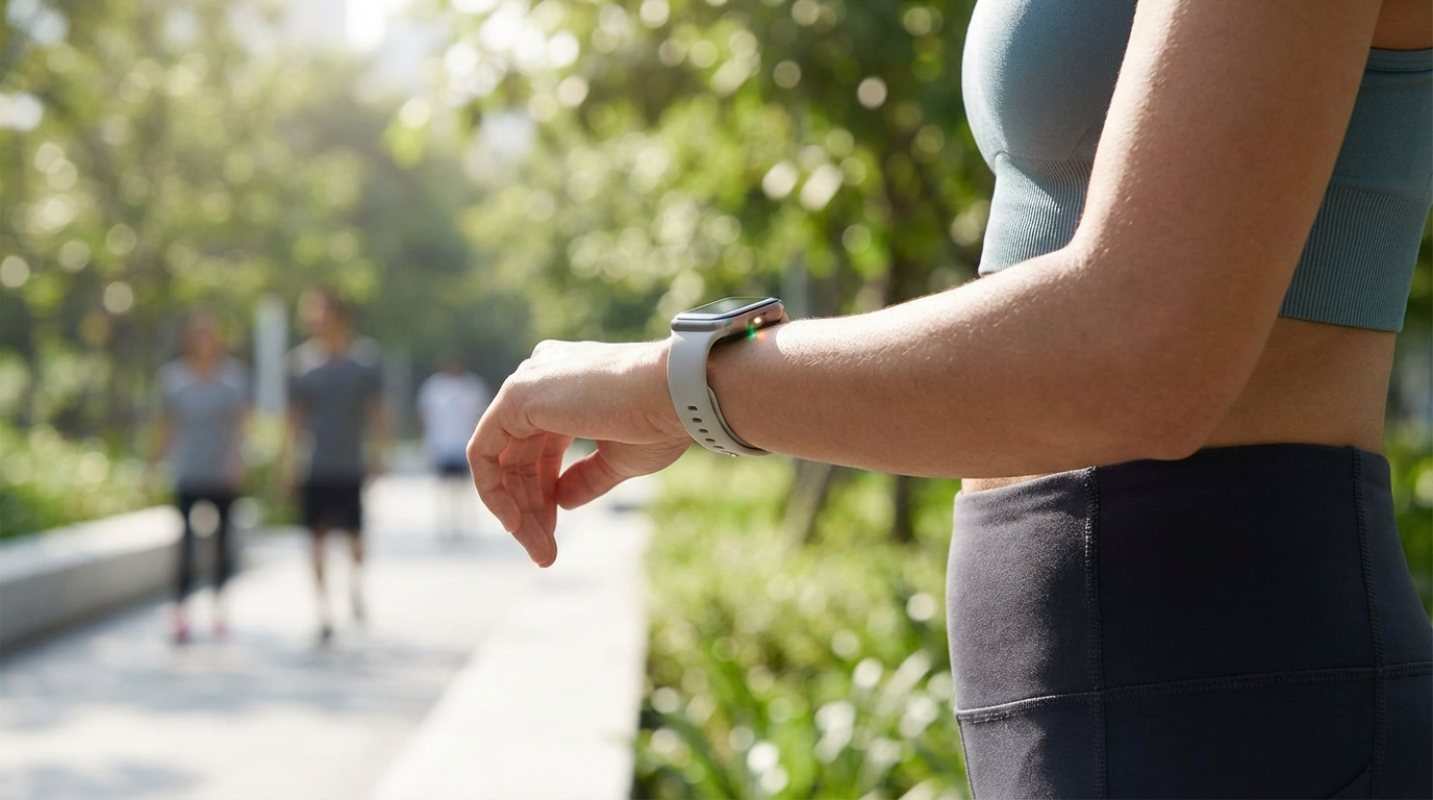
That’s why the quest for truly non-invasive glucose monitoring (NIGM) isn't just a technological challenge; it’s a global health imperative. Imagine checking your glucose levels simply by looking at your watch, or placing a small device on your skin, no blood required. That ease of use promises better patient adherence but potentially better health outcomes for the millions worldwide living with diabetes.
The market certainly reflects this urgency. The global non-invasive glucose monitoring sector was valued at roughly USD 2.9 billion in 2024 and is projected to grow rapidly⁶. But chasing this holy grail means overcoming immense scientific hurdles. How do you measure a tiny molecular change deep beneath the skin, through layers of fat, water, and protein, without drawing blood?
The answer lies in advanced physics and cutting-edge machine learning. We’re going to explore the leading technologies currently battling in clinical trials—the ones most likely to reach your wrist or desk in the next few years.
Optical Spectroscopy: Harnessing Light for Real-Time Readings
The most widely researched path to painless monitoring involves light. Specifically, optical spectroscopy aims to shine different wavelengths of light—often Near-Infrared (NIR) or Raman—onto the skin and measure how that light interacts with glucose molecules in the interstitial fluid.
Think of it like shining a flashlight through colored glass. The glucose molecules absorb and scatter light in a unique pattern, creating a spectral "fingerprint" that can be read by a sophisticated sensor.
The Challenge of Signal Isolation
This sounds simple, but the biological reality is messy. The skin is full of other substances—water, fat, and collagen—that also absorb light. These components create significant noise that can easily overwhelm the subtle glucose signal¹. To achieve the necessary clinical accuracy, developers must employ extremely complex algorithms and powerful machine learning to filter out everything but the glucose reading.
Even so challenge, several developers are nearing the finish line. Companies like Apollon (MOGLU) are focusing on Raman spectroscopy, which analyzes the vibrational modes of molecules, aiming for FDA approval as early as 2025. Similarly, Know Labs launched its wearable sensor, the KnowU, in early 2024, planning to submit the device for FDA clearance quickly. The key innovation here isn't just the sensor, but the proprietary machine learning platform that processes the resulting spectral data.
A promising sub-field is Photoacoustic technology, which uses light pulses to generate tiny, measurable sound waves within the tissue. This method is highlighted as potentially offering higher accuracy because it is less affected by variables like skin pigmentation or temperature variations.
Wearable Sensors: Using Radiofrequency and Acoustic Waves
Although optical methods rely on light, a whole other category of technologies uses the electromagnetic spectrum, specifically radiofrequency (RF) and microwave techniques. These approaches measure changes in the body’s electrical properties.
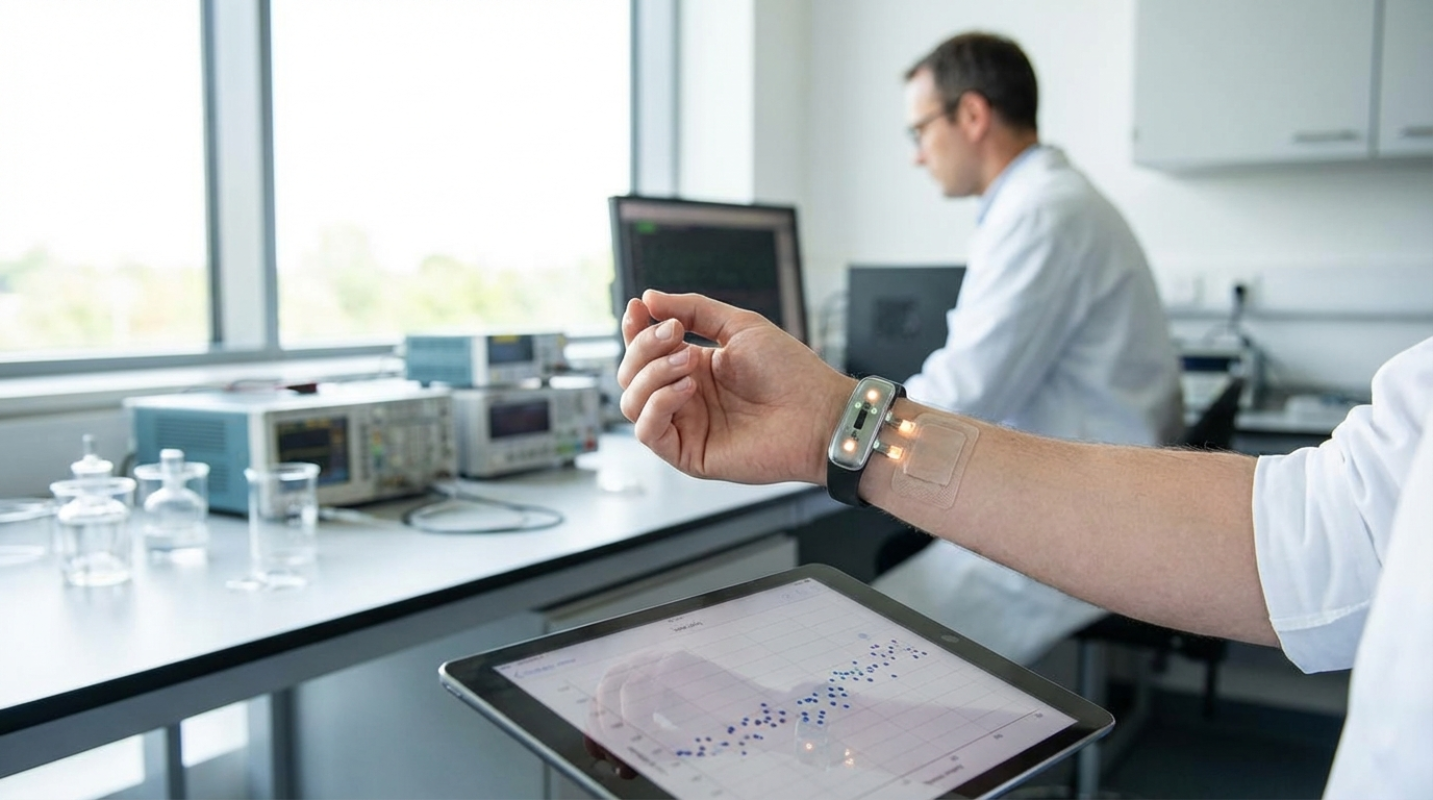
Glucose levels affect the dielectric properties—the ability to store electrical energy—of the body’s tissues. By sending low-power radio waves or microwaves through the skin, developers can measure how the tissue’s electrical resistance or conductivity changes. Since glucose concentration influences the water content and ionic balance in the interstitial fluid, the signal changes as your blood sugar rises or falls.
Miniaturization and Clinical Trials
The recent advancements here are especially exciting because they allow the technology to shrink down to the size of a standard wearable. Engineers at the University of Waterloo, like, developed a miniaturized radar technology small enough to fit inside a smartwatch⁷. As of late 2024, they had a minimum viable product already undergoing clinical trials, specifically targeting integration into consumer wearables.
Afon Technology, with its Glucowear device, is another key player focusing on electromagnetic sensing.
The major hurdle for these RF methods is similar to spectroscopy: isolating the signal. The change in the dielectric properties caused by glucose is minute, and it’s easily masked by movement, sweat, or even slight variations in sensor placement³. This means that success relies heavily on advanced signal averaging and, once again, the intense processing power of Artificial Intelligence to distinguish true glucose fluctuations from background noise.
Biomarker Analysis and the AI Revolution
Not all non-invasive research focuses on measuring glucose directly through the skin. Some groups are exploring indirect biomarkers found in other bodily fluids, like tear fluid, saliva, or sweat.
Although these methods are truly non-invasive, they face a different, fundamental challenge: correlation lag. Glucose in tears or sweat doesn't change instantaneously with blood glucose; there's a delay, which makes these readings difficult to use for immediate therapeutic decisions, such as calculating an insulin dose. Developing highly sensitive electrochemical sensors that can overcome this lag time remains a major area of research.
Another non-optical approach is Bioimpedance Analysis. This technique measures the electrical resistance of the tissue, which, like dielectric sensing, changes based on fluid composition. A 2024 review of AI-based monitoring included studies that used tissue impedance to estimate blood glucose levels⁵. Although promising, impedance-based devices tend to be earlier in the commercialization pipeline compared to the more advanced spectroscopic and radar systems.
The Indispensable Role of Machine Learning
Regardless of the physical method—light, radar, or electrical resistance—there is one common denominator for success: Artificial Intelligence.
AI isn't just a marketing buzzword here; it’s the backbone of NIGM. These non-invasive sensors produce inherently noisy, complex data. Only sophisticated machine learning algorithms can rapidly process these signals, filter out the environmental and biological interference, and translate that data into a reliable, clinically accurate glucose estimate. Without AI, none of the current non-invasive technologies would stand a chance of meeting regulatory standards.
The Accuracy Hurdle and the Regulatory Reality
This brings us to the most important topic: accuracy. For a device to be clinically useful, especially for patients making insulin dosing decisions, it must meet incredibly stringent standards. This accuracy is typically measured by the Mean Absolute Relative Difference (MARD) score. Current CGMs achieve MARD scores in the 8–10% range. Non-invasive devices must get very close to this benchmark.
As of early 2026, the harsh reality is that no truly non-invasive device has been authorized, cleared, or approved by the U.S. Food and Drug Administration (FDA) for clinical use.
The regulatory bodies are rightly cautious. The FDA issued a stern safety warning in February 2024 against using smartwatches or smart rings that claim to measure blood glucose without piercing the skin⁴. Why the caution? Inaccurate readings pose a serious danger, potentially leading to dangerous therapeutic decisions. Basing an insulin dose on an unreliable reading could result in life-threatening hypoglycemia (low blood sugar) or severe hyperglycemia (high blood sugar).
The path through FDA or CE Mark approval requires 18 to 24 months of rigorous clinical testing to prove not just that the device works, but that it works reliably across diverse patient populations, skin tones, and environmental conditions.
Next Steps: When Painless Monitoring Becomes Standard
The current technological race suggests we are nearing a breakthrough. The most advanced companies are targeting FDA submissions in 2025, meaning we could see the first approved products hit the market in late 2026 or 2027.
When these devices finally arrive, they won’t just be replacements for fingersticks; they’ll be catalysts for truly proactive diabetes management. Imagine real-time, continuous data without the physical burden of a sensor insertion. That kind of seamless integration into daily life is the ultimate promise of non-invasive technology.
The focus now shifts from if these devices are possible to when they achieve the clinical reliability required to earn regulatory trust.
The arrival of the first generation of FDA-approved non-invasive monitors will radically redefine what it means to live with diabetes. It's not just about removing the needle; it’s about removing the constant psychological burden of tracking, finally allowing the technology to fade into the background.
Sources:
1. Challenges of non-invasive glucose monitoring
4. AI-Based Non-Invasive Continuous Blood Glucose Monitoring: Systematic Review and Meta-Analysis
5. Non-Invasive Blood Glucose Monitoring System Market
This article is for informational and educational purposes only. Readers are encouraged to consult qualified professionals and verify details with official sources before making decisions. This content does not constitute professional advice.