 (Image source: Gemini / Landon Phillips)
 Imagine being able to regrow a damaged heart muscle, repair a severed spinal cord, or completely heal a chronic diabetic wound, not just treating the symptoms, but restoring full, youthful function. That is the incredible promise of regenerative medicine. At the core of this field are stem cells, the body's master builders, capable of differentiating into any specialized cell type you need.
But here’s the hitch: simply injecting stem cells into a damaged area often results in poor survival, uncontrolled differentiation, or the cells floating away. They need an architectural home, a set of blueprints, and a friendly neighborhood to thrive.
That is where the scaffold comes in. Think of it as the construction site and the foundation combined. Scaffolds provide the necessary physical and biochemical support—the perfect microenvironment—to get the most from stem cell therapeutic potential, guiding them to become the right tissue at the right time. This teamwork is the important bridge transitioning stem cell therapy from the lab bench to the clinic.
Understanding Stem Cell Scaffolds: Biomaterials Meet Biology
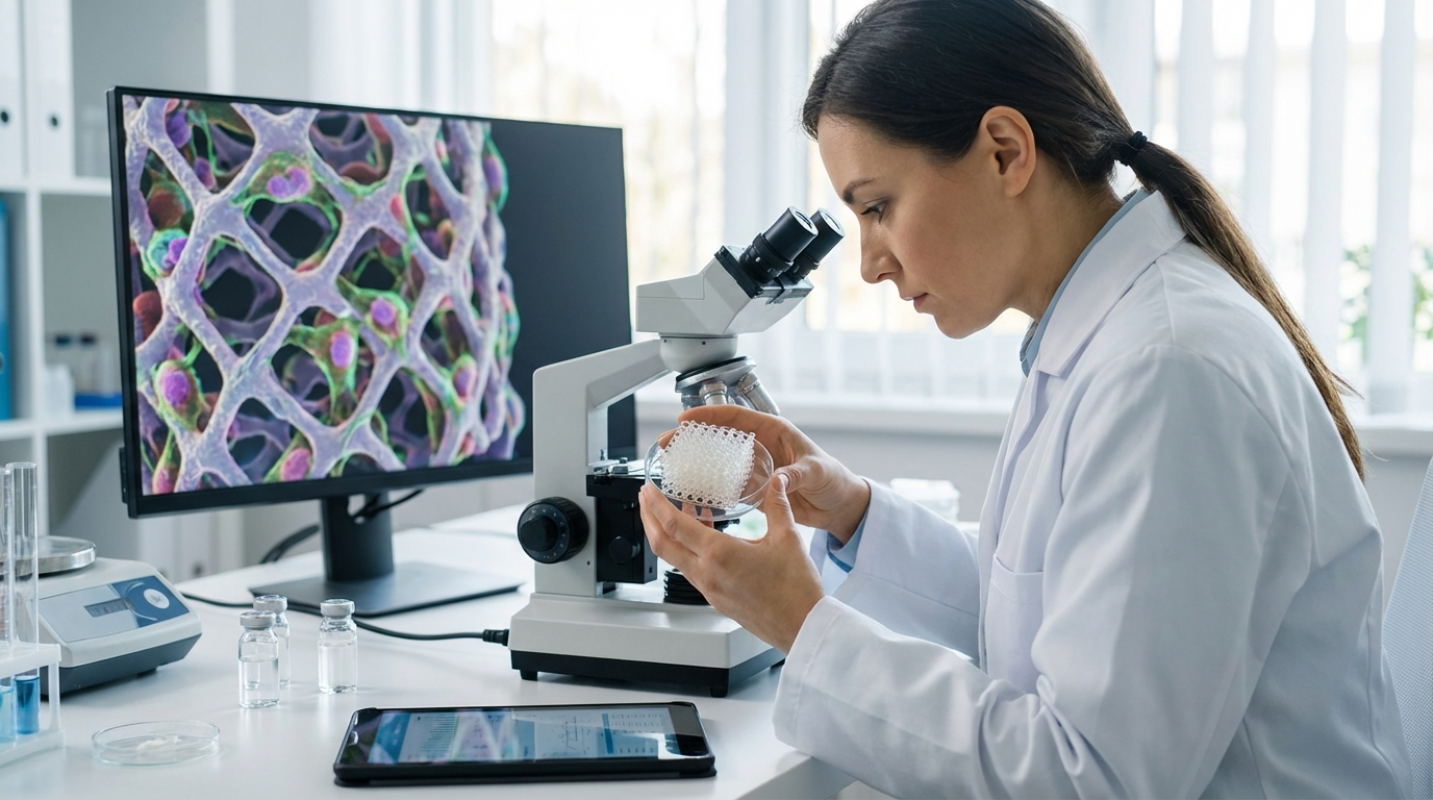
If stem cells are the bricks, the scaffold is the mortar and the frame of the building. Its primary function is to mimic the native Extracellular Matrix (ECM), which is the complex network of proteins and sugars that naturally surrounds and supports cells in your body. Mimicking this environment is important for proper cell adhesion, proliferation, and, most importantly, signaling the cells on what they should become.
So, what are these scaffolds made of? We typically classify them into two main categories
- Natural Polymers
- Materials like collagen, fibrin, and hyaluronic acid. These are highly biocompatible, meaning your body is less likely to reject them, but they often lack mechanical strength.
- Synthetic Polymers
- Materials like PCL (polycaprolactone) and PLA (polylactic acid). These offer incredible customization in terms of mechanical strength and degradation rate, which matters for long-term tissue repair.
The design of the scaffold is everything. Like, if you’re trying to grow new bone, you need a scaffold with high mechanical strongness—it has to be stiff enough to bear weight. Conversely, repairing soft tissue like skin or cardiac muscle requires a much more flexible structure. Current innovative solutions often involve using hybrid scaffolds that combine the flexibility of hydrogels with the necessary stiffness of stronger polymers to better match native tissue properties.
Key design principles also include porosity (allowing nutrients and oxygen to flow in and waste to flow out) and the biodegradability rate. The scaffold must degrade slowly enough to hold the structure while the new tissue forms, but quickly enough to disappear entirely once the job is done, leaving only the patient's regenerated tissue behind.
Cutting-Edge Scaffold Fabrication Techniques
The days of simply pouring cells onto a flat slab of material are long gone. Today's regenerative medicine demands precision, and that means using sophisticated engineering tools to build complex, three-dimensional structures.
The most transformative tool in this space is 3D Bioprinting. This allows researchers to achieve spatial control, precisely placing stem cells and the scaffold material—often referred to as bioinks—layer by layer to create intricate structures that closely resemble native organs.
Think of it like an architect using a highly specialized 3D printer to build a perfect miniature model of a skyscraper, complete with all the internal plumbing. This level of precision is needed for developing complex tissue patches for organs like the liver or kidney. The 3D bioprinting market is growing rapidly, projected to reach over USD 1,647.4 million by 2024 alone, reflecting its immense potential.¹
But the technology is only as good as its materials. Developing the ideal bioink is currently cited by experts as the "most challenging task" delaying widespread progress.² The bioink must be printable (fluid enough to flow through a nozzle) yet structurally sound, and also meet all the physical and biological requirements for cells to differentiate and thrive in vivo.
Another important technique is Electrospinning. This method uses an electric field to draw out ultra-fine polymer fibers, creating nanofibrous scaffolds that closely mimic the spaghetti-like topography of the native ECM. These tiny fibers provide excellent surface area and guidance cues for stem cells, particularly useful in vascular and nerve regeneration.
Finally, we have Smart or Injectable Scaffolds. These are often hydrogels that can be delivered minimally invasively via a syringe. They remain liquid outside the body but respond to physiological cues, like body temperature or pH, to quickly solidify in situ. This capability is a game-changer for delivering therapies deep inside the body, such as into the heart muscle, without major surgery.
Clinical Successes and Emerging Applications
The integration of stem cells and tailored scaffolds is no longer theoretical; it’s translating into real patient benefits across multiple medical disciplines.
Orthopedics was an early adopter, seeing success in cartilage and bone regeneration. If you’ve suffered significant joint damage, you understand that simple grafts often fail. But using a scaffold seeded with mesenchymal stem cells (MSCs) provides the structural integrity needed for the body to rebuild strong, functional tissue.
The most exciting clinical advancements in 2026 are focused on tissue engineering where the challenge is complex, particularly vascularization. Any tissue thicker than a few millimeters needs functional blood vessels to survive. Researchers are addressing this by using temporary or sacrificial materials within the scaffold design, which dissolve after printing to leave behind channels that encourage the patient’s own blood vessels to grow into the construct.
We are seeing significant progress in wound care. Chronic non-healing wounds, such as diabetic foot ulcers (DFUs), are notoriously difficult to treat. Products like Sollagen (PTT-6®), which uses an umbilical cord lining membrane as a natural scaffold and delivery system, have demonstrated remarkable results, showing up to 75% wound size reduction in chronic wounds within weeks.³
Globally, the clinical trial space is booming. As of late 2024, reviews identified 115 global clinical trials involving Pluripotent Stem Cell (PSC)-derived products, with over 1,200 patients dosed. The overall safety profile has been encouraging, with no major class-wide safety concerns reported.⁴
Therapeutic efforts are strongly advanced in ophthalmology, targeting diseases like Age-related Macular Degeneration (AMD) using iPSC-derived retinal pigment epithelium (RPE) cells, and in neurology, where trials for Parkinson’s Disease are assessing the integration of iPSC-derived neural progenitor cells. These trials rely heavily on the scaffold—whether natural or synthetic—to make sure the transplanted cells survive and integrate correctly into the damaged host tissue.
The Important Bridge: Engineering Universal, Immune-Evasive Tissues
Despite the advances, significant hurdles remain. Regulatory approval for these complex living devices is challenging because they don't fit neatly into existing categories (is it a drug, a device, or a biologic?). Plus, scaling up manufacturing from expensive lab prototypes to clinical-grade, accessible production is resource-intensive.
The biggest biological challenge, but is the immune response. If we want to create "off-the-shelf" or allogeneic therapies (cells from a donor), we must prevent the patient’s body from rejecting them.
This is where the future of scaffolding meets advanced genetic engineering. The most transformative development is the unprecedented synthesis of sophisticated cell sources, like iPSCs, with next-generation genome editing tools like CRISPR-Cas9.⁵
Researchers are now using CRISPR to knock out key immune recognition genes (like HLA Class I and II) from iPSC lines before seeding them onto a scaffold. This creates hypo-immunogenic or immune-evasive cells. The ultimate goal is a universally transplantable, customized tissue patch that won't require lifelong immunosuppressant drugs.
The scaffold is the important platform for achieving this. By integrating advanced biomolecules—like growth factors—directly into the scaffold matrix, we can improve the performance of these genetically modified cells in vivo. The combination of smart materials, precise architecture, and immune-evasive cells is the final frontier, promising to deliver true, functional regeneration to the mainstream clinical practice.
Sources:
This article is for informational and educational purposes only. Readers are encouraged to consult qualified professionals and verify details with official sources before making decisions. This content does not constitute professional advice.