 (Image source: Gemini / Landon Phillips)
 Think about your last doctor’s visit. What happened? A nurse likely ushered you in, slapped a cuff on your arm, put a thermometer in your mouth, and recorded your heart rate. That snapshot—a single moment of data—is what traditional healthcare relies on. It’s episodic. It’s often skewed by the stress of being in a clinic.
But what if your doctor could see your heart rate variability, sleep temperature, and blood oxygen levels 24/7, for weeks on end?
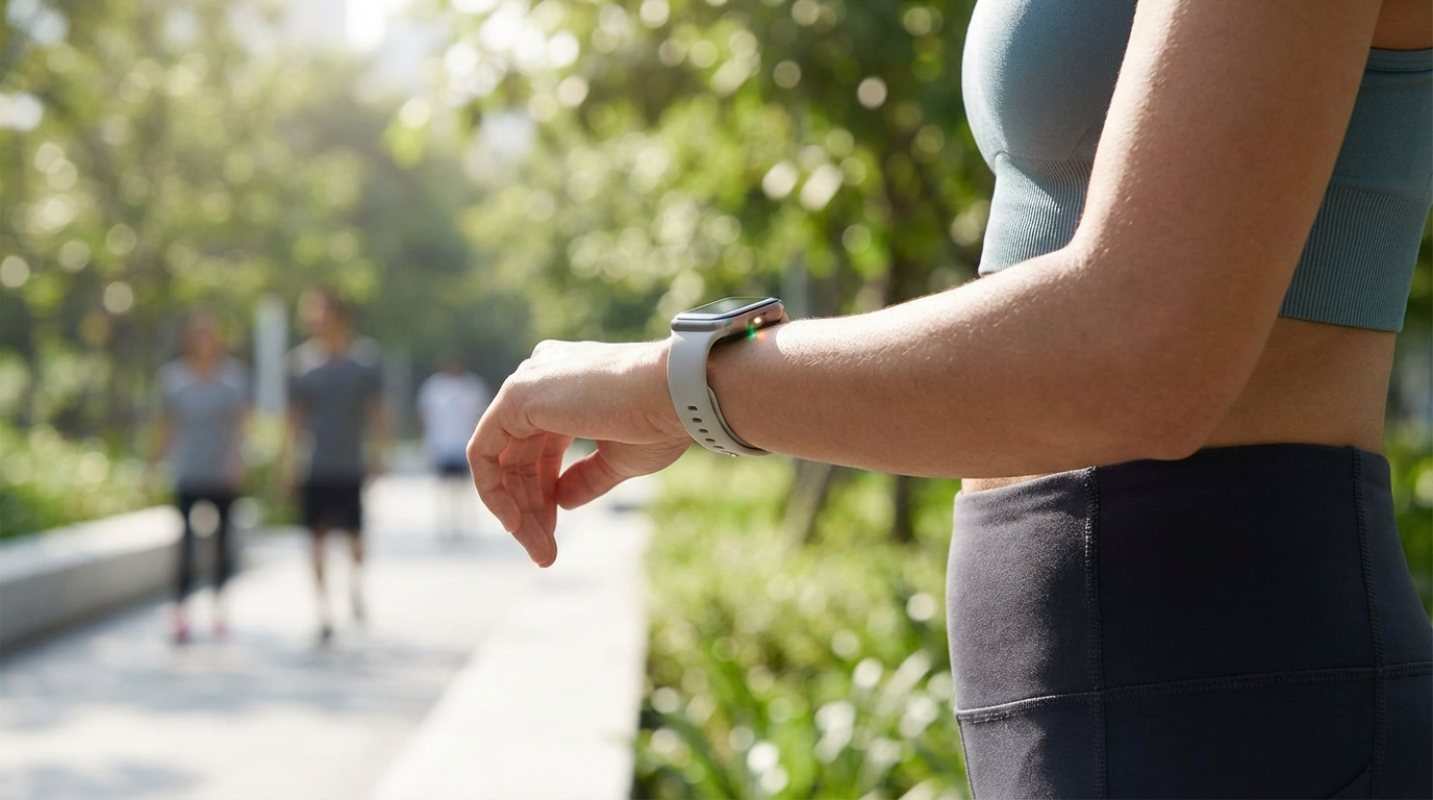
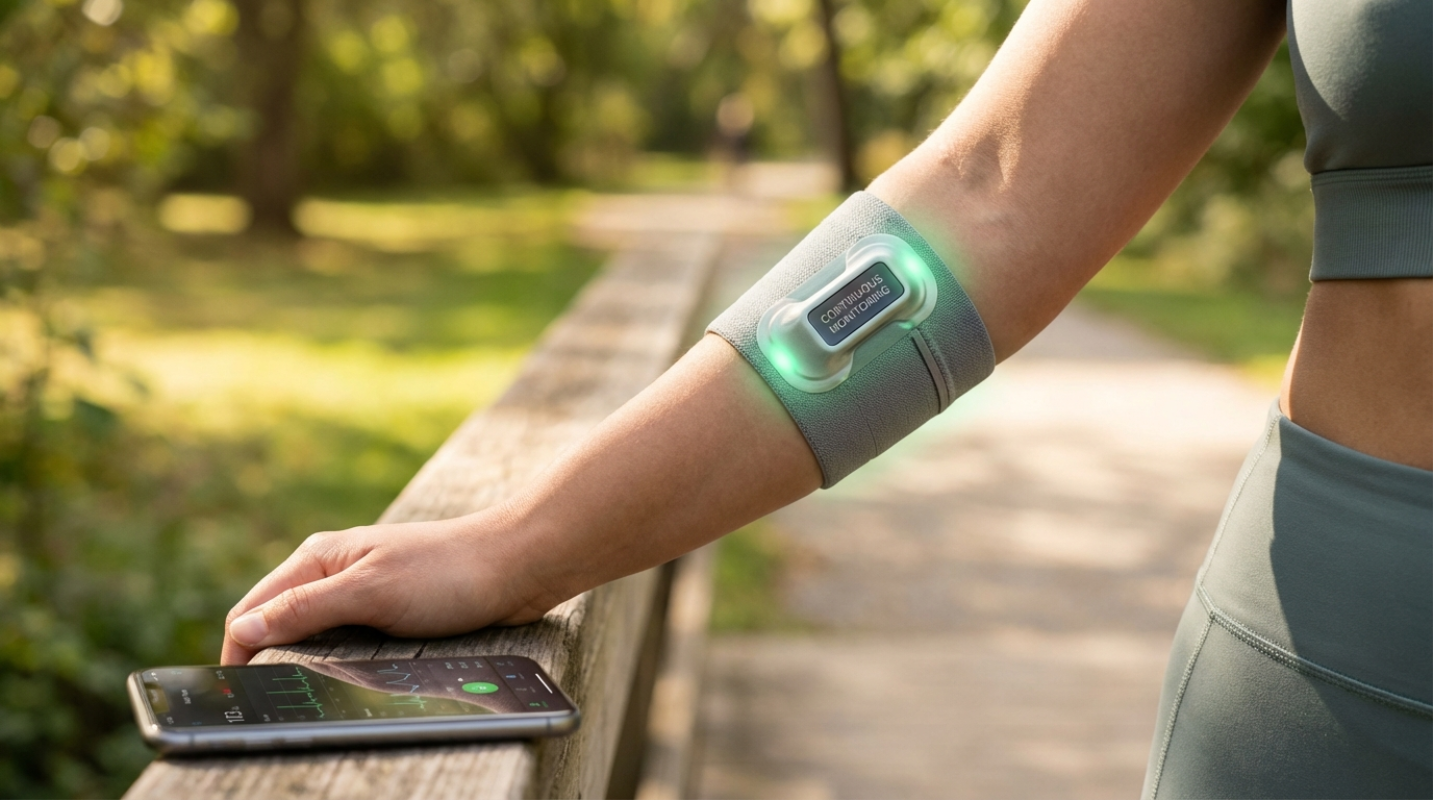
This is the promise of Continuous Key Sign Monitoring (CVSM), powered by wearable biosensors. These aren’t just fancy fitness trackers anymore. They are sophisticated, often medical-grade devices worn directly on the skin—in rings, patches, smartwatches, or even textiles—that capture vast streams of physiological data in real time.
The shift from episodic data to continuous data is revolutionary. It allows us to establish a true, personalized baseline for your health, spotting anomalies—like the onset of an arrhythmia or a subtle temperature spike indicating infection—long before you feel severe symptoms. Wearable biosensors aren’t just collecting data; they’re providing actionable, real-time physiological insights that are fundamentally changing how we approach diagnosis and preventive care.
The Technology Behind the Trend: How Biosensors Work
So, how do these tiny devices manage to read the intimate rhythms of your body?
The key lies in highly sensitive sensing technologies and clever form factors. The parameters monitored are familiar—Heart Rate (HR), Heart Rate Variability (HRV), blood oxygen saturation (SpO2), skin temperature, and respiratory rate—but the method of capture is far more refined than a finger clip at the pharmacy.
Core Sensing Technologies
Most commercial wearables rely on Photoplethysmography (PPG). This optical technique uses LEDs to shine light into your skin and photodiodes to measure the light reflected back. Because blood absorbs light, changes in the volume of blood flowing beneath the skin (caused by your heart beating) create a measurable waveform. This waveform gives us HR, and with advanced algorithms, SpO2.
For a deeper look at cardiac function, many devices now integrate Electrocardiogram (ECG) capabilities. This measures the electrical activity of the heart, offering clinical-grade insights into heart rhythm, important for detecting conditions like Atrial Fibrillation (AFib).
But innovation doesn’t stop there. Researchers are developing highly flexible, body-conforming materials. We’re seeing breakthroughs in e-skin—electronic skin using piezoelectric sensors—with thicknesses as low as 168 μm, making them nearly invisible and highly sensitive to movement and key signs.² Other advancements include using nanomaterials like carbon nanotubes in flexible antennas to improve signal conductivity and allow for truly body-conforming designs.
Form Factors and Function
The form factor dictates the data quality and adherence.
- Smartwatches and Rings: These offer convenience and long-term wearability, excelling at HR, HRV, and sleep tracking. They are the market's current heavy hitters.
- Adhesive Patches: These are often preferred in clinical settings or for specific diagnostic periods (e.g., post-surgery or for AFib monitoring). They adhere directly to the chest or torso, providing extremely stable ECG and temperature data.
- Smart Textiles: Imagine your shirt continuously monitoring your respiratory rate and temperature. Although still emerging, smart textiles promise seamless integration, turning everyday clothing into data collectors.
Clinical Impact and Key Applications
The utility of CVSM spans the spectrum, from optimizing athletic performance to saving lives in important care settings. The global market is booming, projected to reach nearly $56.88 Billion by 2032, driven by the global burden of chronic disease and the rise of digital health.¹
Managing Chronic Disease Remotely
The biggest win for biosensors is in Remote Patient Monitoring (RPM). For patients managing chronic diseases like COPD, heart failure, or hypertension, continuous data is a game-changer. Doctors can track subtle changes in resting heart rate, SpO2, and respiratory patterns, often catching deterioration before it necessitates an emergency room visit.
In cardiovascular health, the ability to continuously track ECG is needed. Devices are now widely used to detect and monitor AFib, providing clinicians with weeks of data rather than a single 15-minute office reading.
Validation Status
It’s fair to ask: Is this data accurate enough for a doctor to trust? The answer is increasingly yes, especially for the core metrics. Recent validation studies confirm that the technology is maturing rapidly. Like, wearable sensor prototypes using PPG for HR monitoring have shown excellent agreement with gold-standard chest straps, with an Intraclass Correlation Coefficient (ICC) of \ge 0.92 for rest and recovery HR.³
For temperature and SpO2, which are harder to measure accurately through the skin, progress is also significant. In clinical settings, new wearable systems are showing impressive reliability, with 99% of their temperature and SpO2 measurements falling within the 5% deviation line compared to reference devices.⁴ That’s clinical-grade performance moving out of the lab and onto your body.
Challenges on the Road to Ubiquitous Adoption
Despite the hype and the incredible technological strides, the path to mainstream integration isn't without hurdles.
One of the most persistent issues is data accuracy in motion. Although resting HR measurement is excellent, the moment you start moving vigorously, artifacts and noise creep in. Studies show that while accuracy is high at rest, clinical validity still needs improvement for measurements like respiration rate and SpO2 during intense activity.
Then there’s the cost and regulatory maze. Medical-grade biosensors are expensive, restricting access for many patients. Plus, the regulatory process for clinical validation (like FDA clearance) is costly and time-intensive, which slows the market entry of innovative, clinically-focused devices. This creates a challenging environment for manufacturers trying to prove their device’s clinical efficacy while keeping prices reasonable.⁵
Finally, we have the issues of data overload and privacy. Continuous monitoring generates petabytes of data. How do clinicians, already pressed for time, effectively sift through months of HR data to find the single relevant anomaly? The answer lies in effective integration with AI, which we’ll discuss next.
And of course, there are the important concerns around security and privacy. If your most intimate physiological data is stored in the cloud, who owns it? Healthcare systems must guarantee compliance with regulations like HIPAA and GDPR to maintain patient trust.
The Age of Predictive Health
We stand at the cusp of a major transformation. Wearable biosensors have proven their ability to collect high-quality data. The future isn't just about collection; it's about prediction.
This is where Artificial Intelligence (AI) and Machine Learning (ML) become indispensable partners. AI takes the raw streams of HR, temperature, and SpO2 data and transforms them into predictive models. It can identify patterns indicative of sepsis, cardiac deterioration, or even viral infections days before symptoms manifest.
Imagine a system that learns your unique baseline and immediately alerts you (and potentially your physician) the moment your HRV drops significantly alongside a 1-degree temperature increase—a potential signal that you need to rest and hydrate, or perhaps get tested for illness. This moves healthcare from reactive treatment to proactive intervention.
The ultimate goal is the creation of closed-loop systems. These systems won’t just monitor; they will act. Think of a sensor patch detecting dangerously low glucose levels and automatically signaling an insulin pump, or a device sensing a severe arrhythmia and autonomously alerting emergency services.
The integration of wearables into mainstream medicine requires a powerful partnership: technology developers must refine sensor accuracy and battery life; clinicians must trust and integrate the data into their workflow; and patients must commit to adherence. When these three elements align, CVSM will become less of a novelty and more of a standard, needed tool for personalized health management, ushering in the age of health foresight.
Sources:
1. Wearable Biosensors Market Size
2. E-Skin and Flexible Electronics
3. Wearable Sensor Prototype for HR Monitoring
4. Clinical Deterioration Prediction Model Study
This article is for informational and educational purposes only. Readers are encouraged to consult qualified professionals and verify details with official sources before making decisions. This content does not constitute professional advice.