 (Image source: Gemini / Landon Phillips)
 For decades, fitness felt like a guessing game. You ran until you were breathless, lifted until you couldn't move, and measured success purely by soreness and exhaustion. We mistakenly equated working out hard with training smart. That era is over.
Today, thanks to sophisticated wearable technology, we have moved into the age of data-driven fitness. The core concept driving this revolution is the Heart Rate Zone. Think of your heart rate as your car’s engine RPM gauge. The zones tell you exactly what kind of fuel your body is burning, what physiological system you are targeting, and whether you are training effectively or just spinning your wheels.
Heart rate zones are simply defined percentages of your maximum heart rate (MHR). They provide a direct, objective measure of your effort and stress level. This matters because different zones trigger vastly different biological adaptations, whether your goal is building base endurance, improving speed, or improving recovery.
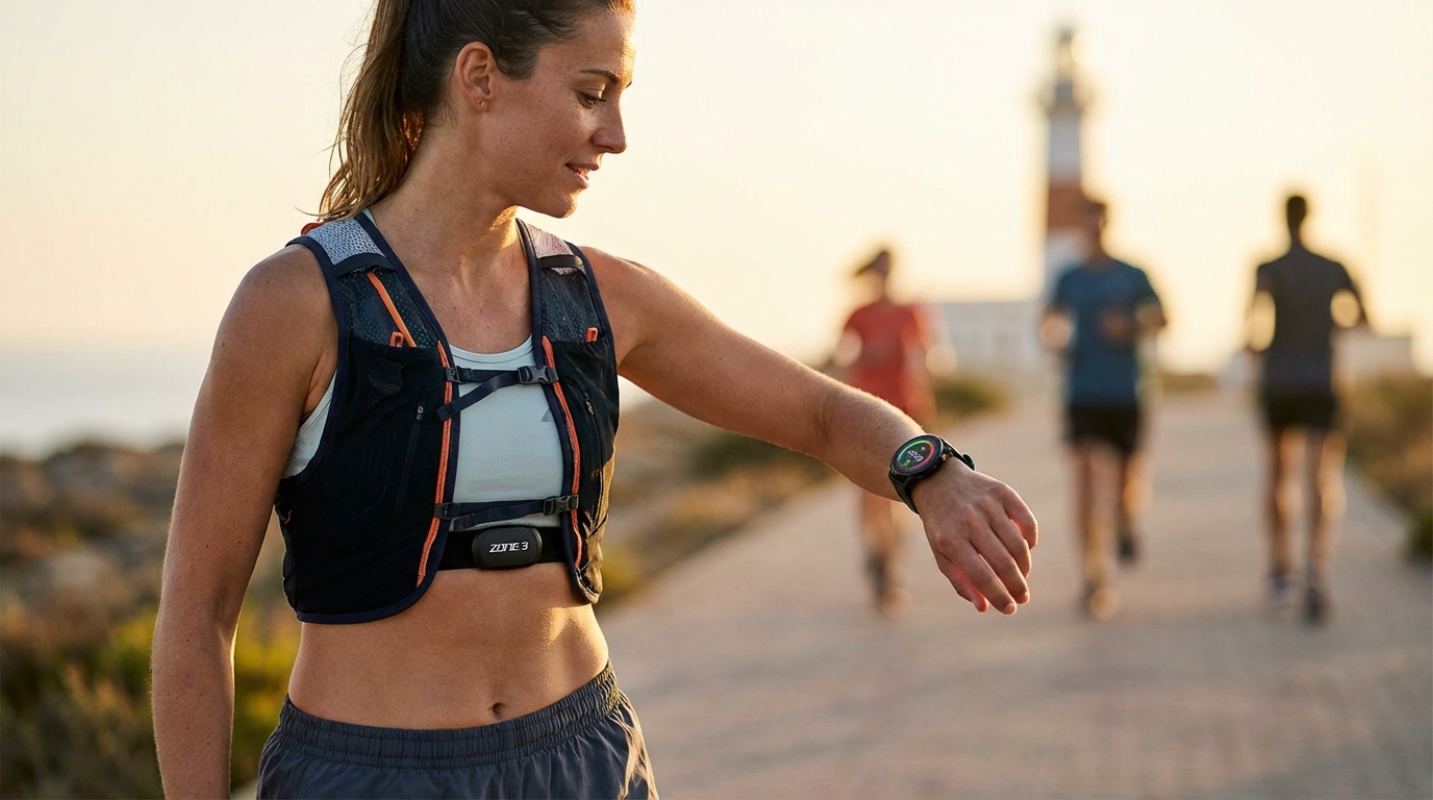
Modern wearables—the smartwatches, fitness rings, and chest straps we rely on—aren’t just counting steps anymore. They are the delivery mechanism, providing real-time coaching. They act as your personal fitness GPS, making sure you stay on the best route for your specific goal. Using wearable-guided zone training isn't just helpful; it’s the most efficient way to optimize results for every fitness level, from the marathoner to the weekend walker.
Decoding Your Zones: From Resting to Maximum Effort
To train using zones, you first need to know your zones. The standard model divides effort into five distinct categories, ranging from Z1 (Very Light) to Z5 (Maximum Effort).
- Zone 1 (50–60% MHR): Recovery, warm-up, and cool-down.
- Zone 2 (60–70% MHR): Aerobic Base. This is the sweet spot for improving metabolic flexibility and increasing mitochondrial density.
- Zone 3 (70–80% MHR): Aerobic Capacity. Often called the "tempo" zone, where you can maintain effort but conversation becomes difficult.
- Zone 4 (80–90% MHR): Anaerobic Threshold. This is hard work, where lactate production begins to outpace clearance.
- Zone 5 (90–100% MHR): Max Effort. Short bursts, pure speed, and pain.
Calculating Your True Zones
Many fitness trackers rely on the simplest, but often least accurate, method: 220 minus your age. For highly trained individuals, this formula can be wildly misleading.
If you want personalized accuracy, you need to account for your fitness level. The most recommended personalized method for athletes outside of a lab is the Karvonen Formula.¹ This method uses your Heart Rate Reserve (HRR), which is the difference between your Max Heart Rate and your Resting Heart Rate. Accounting for your RHR means your zones reflect your current physiological state, not just your birthday.
The Magic of Zone 2
Why do experts constantly emphasize Zone 2? Because it’s where you build the foundation. Training in this zone is superior for long-term cardiovascular health and longevity because it improves vascular compliance and dramatically increases the number and health of your mitochondria.⁵
If you spend all your time in the middle (Zone 3), you end up training too hard to recover properly, but too easy to trigger high-end performance gains. You get stuck in the "Gray Zone." Zone training, guided by your wearable, prevents this inefficiency.
The Wearable Advantage: Real-Time Guidance and Feedback
The biggest differentiator in modern training isn't the data itself; it's the ability of your wearable to translate that raw data into actionable guidance in the moment.
Think about your last long run. Did you slow down when you felt tired, or did you slow down when your watch alerted you that you had drifted into Zone 3? That’s the difference between subjective effort and objective training.
When you start a Zone 2 workout, the wearable constantly monitors your pulse and provides immediate feedback. If you speed up slightly and your heart rate creeps toward 75% MHR, your device vibrates or beeps, instructing you to back off. This stops Zone Creep—the accidental over-exertion that sabotages the intended physiological adaptation.
Conversely, during a rigorous HIIT session targeting Zone 4, the wearable make sures you are pushing hard enough. The guidance moves you past the mental barrier of "This feels hard" to the objective data point of "I am achieving the necessary intensity."
Accuracy Matters
For zone training to work, the data must be reliable. Here’s a important distinction to understand
- Optical Sensors (Wrist/Arm): These are fantastic for convenience, all-day tracking, and low-intensity workouts (like Zone 2). But during high-intensity or activities with rhythmic arm motion (like running fast or weightlifting), optical sensors can struggle. They sometimes suffer from signal crossover, mistaking movement for a heartbeat signal, leading to inaccurate readings.⁴
- Chest Straps: If you are serious about precise Zone 4 or Zone 5 interval training, the chest strap remains the gold standard. They use electrical signals (ECG-based) and are incredibly accurate, often achieving 99.6% accuracy compared to clinical ECG readings.²
For important zone work, most coaches recommend pairing a chest strap with your smartwatch or phone application to guarantee you are truly hitting your targets.
Programming Your Progress: Structuring Workouts Around Zones
How do you integrate this data into a meaningful training plan? You don’t need to hit Zone 5 every day. In fact, that's a recipe for burnout.
The most effective approach for endurance and overall health, favored by experts, is the Polarized Training Model, often called the 80/20 rule. This approach suggests spending approximately 80% of your total training volume in easy Zones 1 and 2, and 20% in hard Zones 4 and 5.
A Sample Zone-Guided Training Week:
1. Monday (Recovery): 45 minutes in Zone 1 (Active recovery walk or light bike).
2. Wednesday (Threshold Power): 60 minutes, including 4 x 8 minutes in Zone 4 (Anaerobic Threshold), guided by immediate wearable alerts.
3. Saturday (Endurance Base): 90 minutes focused entirely on maintaining Zone 2 (Conversational pace).
This structure make sures that your easy days are truly easy, allowing you to recover and build mitochondrial volume, while your hard days are truly hard, pushing your VO₂ max.
For beginners, zone training offers a important safeguard: it prevents overtraining. By forcing you to stay within Zone 2 on your easy days, your wearable make sures you are properly recovering. Integrating this heart rate data with other metrics, like nightly Heart Rate Variability (HRV) readings from your wearable, gives you a complete view of when your body is truly ready for high-intensity stress.
Optimizing the Engine: Future-Proofing Your Training
The adoption of wearable guided workouts using heart rate zones represents a fundamental shift toward efficiency and personalization in fitness. It moves the focus away from simply logging minutes and toward achieving specific physiological adaptations.
The combination of Zone 2 and high-intensity work is powerful because the benefits are distinct yet complementary. Zone 2 builds the size of the engine, increasing mitochondrial volume and metabolic flexibility.⁵ Meanwhile, the targeted intensity of Zones 4 and 5, often achieved through HIIT, rapidly improves the engine’s power, boosting cardiovascular capacity and VO₂ max.⁶
Looking ahead, the integration of heart rate zone data with artificial intelligence promises even greater personalization. Future wearables won't just tell you what zone you’re in; they will use predictive modeling based on your sleep, HRV, and stress data to tell you what zone you should be targeting today.
This data-driven approach removes the guesswork and makes training sustainable. You don’t need to be an elite athlete to benefit from this precision. You just need a wearable that can tell you when to push and, perhaps more importantly, when to back off.
Sources:
1. Karvonen Formula Heart Rate Training Calculator
2. Should I Use a Chest Strap or Watch Heart Rate Monitor?
3. Optical vs. Chest Strap HR Accuracy
4. Are Wrist-Based Heart Rate Monitors Accurate?
5. Zone 2 vs. HIIT: Exploring the Benefits of Both Styles
This article is for informational and educational purposes only. Readers are encouraged to consult qualified professionals and verify details with official sources before making decisions. This content does not constitute professional advice.