 (Image source: Gemini / Landon Phillips)
 If you or someone you love has ever battled Major Depressive Disorder (MDD), you know the diagnosis is a frustratingly blunt instrument. The current standard, defined by symptom checklists in the DSM-5, treats MDD as a single, monolithic illness. But think about it: if one person’s depression is defined by fatigue and lack of motivation, and another’s is dominated by anxiety and crushing guilt, are they really suffering from the same biological problem?
The answer, increasingly, is no. This heterogeneity problem is why treatment often feels like a guessing game. A doctor prescribes an antidepressant, waits six weeks, and if it fails—which it frequently does—they try another. It’s an inefficient, trial-and-error process built on subjective symptoms, not objective biology.
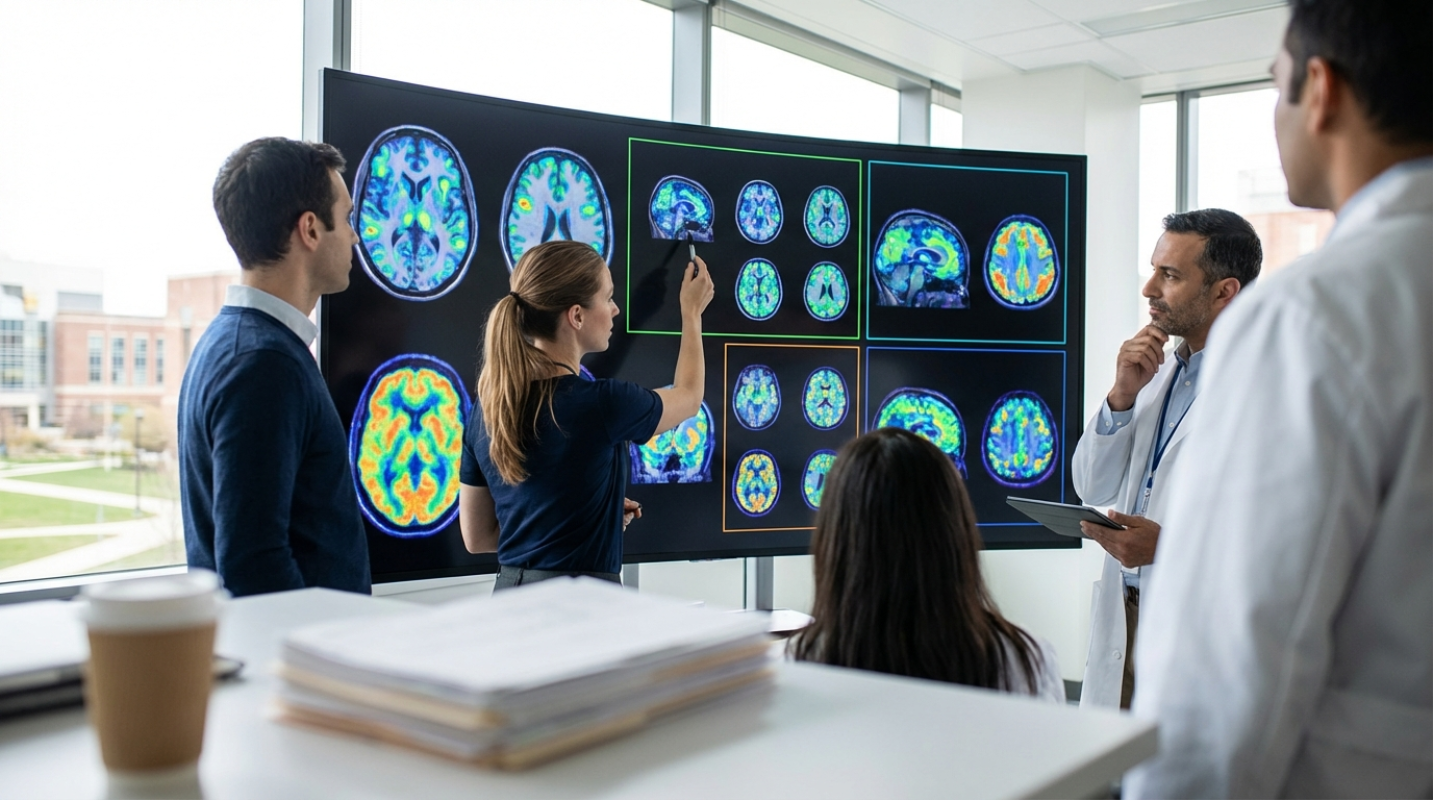
This is where neuroimaging steps in. We’re finally moving beyond the subjective questionnaire and using tools like functional Magnetic Resonance Imaging (fMRI), Positron Emission Tomography (PET), and Electroencephalography (EEG) to map the brain’s unique electrical and chemical failures. Neuroimaging is the objective tool for biomarker-driven classification, allowing us to identify distinct biotypes of depression. It’s the digital equivalent of an internal road map, showing us exactly where your brain’s circuits are failing.
The Neurobiological Space: Key Brain Regions Implicated in Depression
To understand depression subtypes, you first need to know which brain networks are involved. In simplified terms, three major networks govern mood, thought, and action. When depression hits, these networks don't just malfunction; they often fight each other.
1. The Default Mode Network (DMN): This is the network responsible for self-reflection and rumination. In many depressed patients, the DMN is hyperactive, meaning they get stuck in cycles of negative self-talk—the mental equivalent of a car spinning its wheels in mud.
2. The Salience Network (SN): This network determines what information is important (salient) and what we should pay attention to.
3. The Executive Control Network (ECN): This is your brain’s CEO, responsible for planning, focus, and cognitive control.
In typical MDD, we see a functional tug-of-war. The emotional processing centers, like the amygdala and subgenual cingulate, show hyperactivity, driving feelings of fear and sadness. Meanwhile, the ECN, located primarily in the prefrontal cortex (PFC), struggles with hypoactivity, leaving the patient unable to control their emotional output or focus on tasks.
Neuroimaging helps us distinguish between structural issues (is the wiring physically intact, detectable by structural MRI?) and functional issues (is the electricity flowing correctly, detectable by fMRI or EEG?). Structural changes, such as a widespread reduction in cortical thickness, are often seen in severe cases, particularly those associated with Treatment-Resistant Depression (TRD).⁹
Neuroimaging Signatures: Classifying Major Depression Biotypes
The real power of neuroimaging is its ability to stratify patients into groups that share a common biological mechanism, rather than just common symptoms. This is where machine learning meets neuroscience, sorting thousands of data points into meaningful clusters.
Biotype 1: The Connectome Subtypes
Recent research involving large cohorts (over 2,000 participants) has already identified two distinct neurophysiological subtypes based purely on functional connectivity patterns, known as connectome biotypes.²
- Subtype A (Limbic Overdrive): This group shows severe deviations, specifically increased connectivity (positive deviations) within the DMN, limbic, and subcortical areas. These individuals are often dominated by intense emotional dysregulation and rumination.
- Subtype B (Cognitive Deficit): This group might show decreased connectivity in attention and sensorimotor areas, pointing toward a primary deficit in cognitive control and processing speed.
Importantly, these two subtypes showed meaningful differences in symptom severity and, more importantly, in the ability to predict antidepressant treatment outcomes.²
Biotype 2: The Six Biological Signatures
In a major breakthrough announced in 2024, a Stanford Medicine-led study used fMRI and machine learning to sort depression into six biological subtypes.¹ This wasn’t just an academic exercise; the classification was specific enough to identify which common treatments were more or less likely to succeed for three of those subtypes. This is the definition of precision psychiatry in action.
Biotype 3: The Metabolic/Inflammatory Subtype (PET)
Although fMRI maps connectivity, PET scans characterize the neurochemical and metabolic state of the brain. PET matters for identifying the Inflammatory/Metabolic subtype. If you see reduced glucose metabolism or elevated inflammatory markers (using specialized radioligands), you’re looking at a depression driven by mechanisms outside the typical neurotransmitter imbalance. This biotype requires anti-inflammatory or metabolic interventions, not just another SSRI.
The Rise of EEG and Personalized Treatment Prediction
MRI is powerful, but it’s expensive, slow, and inaccessible to many clinics. This is why EEG is rapidly emerging as a front-runner in practical biomarker development. It measures electrical activity with high temporal resolution, and it’s relatively cost-effective.
Experts in 2024 view EEG as an increasingly reliable tool for developing psychiatric biomarkers.⁵ Machine learning applied to EEG features can already achieve classification accuracy up to 88.2% in distinguishing MDD patients from healthy controls.³ Specific markers, such as higher absolute power in the theta and beta bands, are proving to be promising objective electrophysiological indicators.⁴
So what does this mean for treatment?
Imaging findings are becoming powerful predictors. If your neuroimaging reveals a specific pattern of DMN resting-state activity, doctors might use that data to predict whether an SSRI will even be effective for you.
Plus, if your scan shows a localized functional failure—say, hypoactivity in the left dorsolateral PFC—the doctor can use that map to guide neuromodulation techniques. Transcranial Magnetic Stimulation (TMS) or transcranial Direct Current Stimulation (tDCS) can be precisely focused on the dysfunctional circuit, making the treatment highly personalized and far more effective than generalized application.
Charting the Path to True Precision Psychiatry
We’ve established that neuroimaging offers objective stratification far beyond subjective symptoms. But we’re not quite at the point where every patient gets a brain scan before receiving a prescription.
The biggest challenge facing the field right now is low concordance across subtyping solutions. If a researcher uses structural MRI, they might identify one set of subtypes. If another uses functional MRI, they might find a different set. The choice of the measure substantially impacts the identified neuro-subtypes, even if each solution is internally valid.⁶
The solution lies in multimodal data fusion. We can’t rely on a single image. We must combine structural features, functional connectivity (fMRI), and electrical activity (EEG) into one complete profile. By integrating these data streams, personalized federated learning algorithms have achieved impressive classification accuracy—around 79% across multiple sites and thousands of subjects.⁸
The future of depression care won't rely on a single doctor’s hunch or a patient’s self-report. It will integrate your brain scan (the biotype), your genetics (GxE interactions), and your peripheral biomarkers (like inflammation levels) to create a single, objective profile. We are moving away from treating an abstract disease called "depression" and toward treating your unique, measurable brain signature. That’s the promise of true precision psychiatry.
Sources:
1. Stanford Medicine-led study sorts depression into six biological subtypes
2. Major Depression Subtypes Identified by Neuroimaging
3. Mood Disorder Severity and Subtype Classification Using Multimodal Deep Neural Network Models
This article is for informational and educational purposes only. Readers are encouraged to consult qualified professionals and verify details with official sources before making decisions. This content does not constitute professional advice.